

CropDriven Irrigation Project Receives Funding
CropDriven Irrigation is an innovation project focused on the development and practical validation of a digital, crop-driven irrigation solution for agriculture in the Northern Netherlands. The project addresses increasing drought and uncertainty surrounding water availability as a result of climate change. At the same time, there is a growing need for more efficient water use, energy savings, and further digitalisation of agriculture.
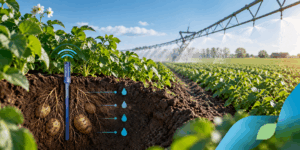
In current practice, irrigation decisions are often based on experience, fixed schedules, or soil moisture measurements alone. As a result, it is not always clear how much water a crop actually needs. CropDriven Irrigation therefore combines real-time measurements of crop water demand (ETa) with soil moisture data. This provides a more complete picture of the water balance and allows irrigation to be more precisely tailored to the crop’s actual needs.
The project is being carried out by a consortium led by CropX, in collaboration with Van den Borne Projecten as the knowledge and validation partner. Field trials are taking place at four agricultural SMEs in the Northern Netherlands: Mts. Wollerich, Mts. Sterenborg, Mts. Zijlma, and Veefokbedrijf Hoving. These farms serve as living labs, where the technology is tested over multiple growing seasons in both arable farming and grassland.
The aim is to advance the technology from TRL 4 to TRL 7 and deliver an irrigation system that has been validated under real-world farming conditions. The system is expected to achieve water savings of 10–20% and energy savings of 5–15%, without negatively affecting yield or crop quality. For participating farmers, the technology could result in lower costs, greater yield security, and improved drought risk management. In addition, a large amount of field data will be collected to support further knowledge development and scaling to other regions and, ultimately, international agriculture.